

Your partner said they would be home by six. It is now twenty to seven, and they have not answered your text. Within a minute, your mind has built a story: an accident, a phone call from the hospital, and how you will cope on your own.
That is catastrophising, and it is far more common than most people admit. Nothing is wrong with you. Your brain learned this pattern, and it is not a flaw in your character. Your brain’s alarm system drives it, which I explain in Why Your Brain Keeps Sounding the Alarm. In this article, I explain what catastrophising is, why your brain does it, and a two-minute exercise to slow it down.
What catastrophising is (and what it isn’t)
Catastrophising means jumping to the worst possible outcome and believing you would not cope. The thought arrives fast. It feels like a fact, not a guess.
It is not a diagnosis. Instead, it is a thinking style, and many people fall into it when they feel tired, stressed, or unsure what comes next.
You may recognise some of these
- You lie awake running “what if” chains, each one worse than the last.
- A slow reply to your message feels like proof that someone is upset with you.
- One small mistake at work turns into “I’m going to lose my job”.
- You rehearse a hard conversation in your head, and it always goes badly.
- A new body sensation quickly becomes a serious illness in your mind.
- You put off a phone call or an appointment because you feel sure it will go wrong.
Planning versus catastrophising
Planning and catastrophizing can look alike, but they feel different. Planning ends with a step: “I’ll leave earlier so I don’t miss the train.”
Catastrophising ends with dread: “I’ll miss the train, lose my job and never recover.”
A simple test helps. Ask yourself whether the thought leads to an action or only to more fear. A useful plan gives you something to do. A catastrophe story only gives you something to feel.
Why your brain jumps to the worst case
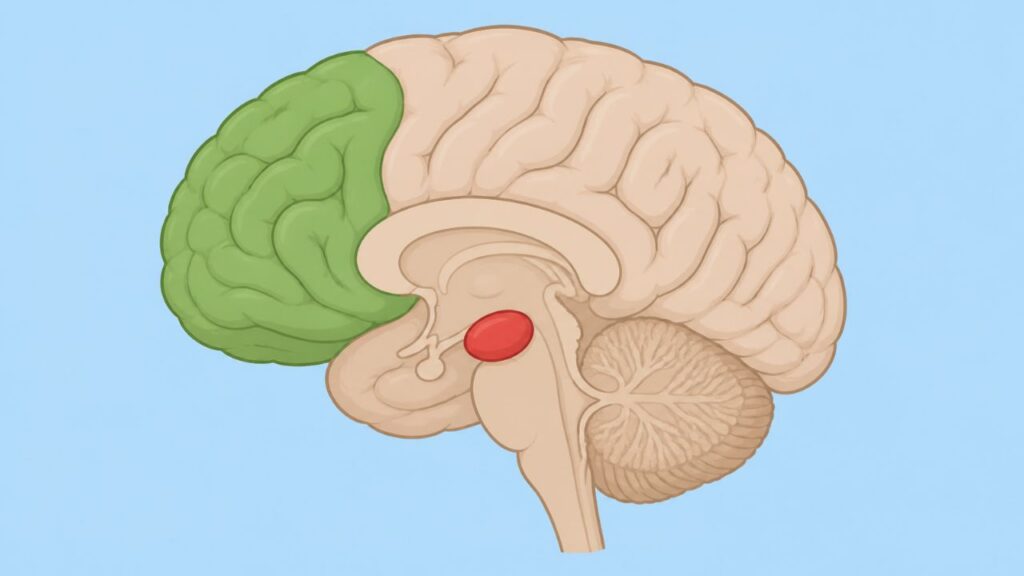
Your brain’s first job is to keep you safe. To do that, it predicts what might go wrong before it happens. Most of the time, this helps.
Two areas play a big part. The amygdala acts as your alarm system. The prefrontal cortex is your thinking brain, which weighs the evidence and keeps things in perspective. You can read more about both on the Brain Basics page. When you feel stressed or tired, the alarm gets louder, and the thinking brain struggles to keep up.
Think of a weather app that only shows storm warnings. Open it often enough, and you start to believe a storm is always on its way. Your brain does something similar. When the future feels uncertain, it expects danger. Missing a real threat costs far more than a false alarm, so it plays safe. When the future feels uncertain, it expects danger. Missing a real threat costs far more than a false alarm, so it plays safe.
Researchers have studied this pattern too. A 2016 paper by Resham Gellatly and Aaron Beck in Cognitive Therapy and Research describes catastrophic thinking as a process that magnifies a perceived threat. It also describes a loop. Once you expect danger, your attention locks onto anything that looks like it, and you read unclear situations as bad news. That confirms the fear, and the loop starts again.
Where the habit comes from
For many people, expecting the worst began as a survival strategy. Imagine growing up in a home where moods changed without warning, or where criticism could arrive at any moment. Staying on guard made sense. Being braced felt safer than being caught off guard.
The same can happen after bullying, a frightening event, or a long, stressful period. If this sounds familiar, you may find The Long-Term Effects of Bullying in Adulthood helpful. Your brain learned that bad things can arrive without notice, so it began scanning for them.
None of this is your fault. You learned the habit for a good reason. With practice and repetition, your brain can learn a different response.
How catastrophising affects your body and your day

Your body reacts to the story as if it were real. Your heart speeds up, your shoulders tighten, and sleep gets lighter.
The habit also shapes your choices. You may put off a task because you expect it to go badly. Or you may ask other people for reassurance again and again, feel calm for ten minutes, and then feel the doubt return. Many people also start avoiding things that matter to them.
Picture someone with a presentation on Friday. By Wednesday, they have imagined going blank on stage, facing a silent room and losing their reputation. The dread feels so heavy that they stop preparing. The presentation goes worse than it needed to, and their mind says, “I knew it.”
Each time you avoid something, your brain misses the chance to see that things turned out fine. That keeps the habit going. The good news is that you can break the cycle at any point, and the next section shows you how.
A two-minute exercise to interrupt the spiral

Try this the next time your mind races to the worst case.
- Name it. Say to yourself, “This is catastrophizing.” Naming the pattern gives you a little distance from it.
- Breathe out slowly. Breathe in gently for four counts, then out for six to eight. Repeat for about a minute. The long out-breath tells your body it can settle.
- Ask three questions. What is most likely to happen? If the worst did happen, what would I do next? Did I have a bad experience in my life similar to this situation?
Go back to your late partner. Most likely, they are stuck in traffic, or their phone battery has died. If something had gone wrong, you would call their friends, then the hospital, and ask for help. And have you felt this same fear before, perhaps long before today?
The third question helps you notice whether your alarm is reacting to today or to something from your past. If a memory feels too heavy, stop there. Take another slow breath, look around the room, and name five things you can see. Then reach out to someone you trust.
When to seek professional help
This article offers general education. It does not replace advice from a health professional.
Consider reaching out if your worry is constant, triggers panic, or disrupts your sleep, work, or relationships. You can also seek support if you feel stuck, even after trying your own strategies.
In New Zealand, you can call or text 1737 free of charge to talk with a trained counsellor at any time. In an emergency, call 111. The Mental Health Foundation of New Zealand also publishes a practical guide, Anxiety and How to Manage It.
What to read next
- Why Does My Brain Keep Sounding the Alarm? explains the alarm system behind your worst-case thoughts.
- Irrational Fears shows why a fear can feel so real, even when you know it is out of proportion.
- Hidden Anxiety lists 12 subtle signs that are easy to miss.
If catastrophising takes up too much space in your life, you do not have to work through it alone. I use BWRT (Brain Working Recursive Therapy), which works with the brain’s automatic patterns. You can book a free discovery call through my anxiety page.